
Given little to no notice of the six-year increase to their state pension age, a generation of women are fighting back against inequality, ageism and institutional mismanagement.
“The abrupt and poorly implemented change in the state pension age for women from 60 to 66 has severely and unconscionably penalised those who were on the cusp of retirement and who had well-founded expectations of entering the next phase of their lives”.
The words of Philip Alston, the United Nations rapporteur on extreme poverty and human rights, whose damning report on the state of poverty in Britain laid bare the shocking impact austerity has had on women in the UK.
In the report, published in November, Alston discusses how recent government policies have “perpetuated rather than tackled the gendered aspects of poverty”, acknowledging that women in the UK “earn less than men, shoulder a greater amount of unpaid labour and are more likely to experience poverty”.
The UN rapporteur points out that even in 2018 women were paid 17.9% less per hour on average than men, made up 60% of low pay workers and were disproportionately engaged in part-time work with little wage progression.
“Given the structural disadvantages faced by women, it is particularly disturbing that so many policy changes since 2010 have taken a greater toll on them,” Alston states, in a report where he suggests women, particularly poor women, have been “intentionally targeted” by the government.
His recommendation? To review and remedy the “systematic disadvantage” inflicted on women by current policies.
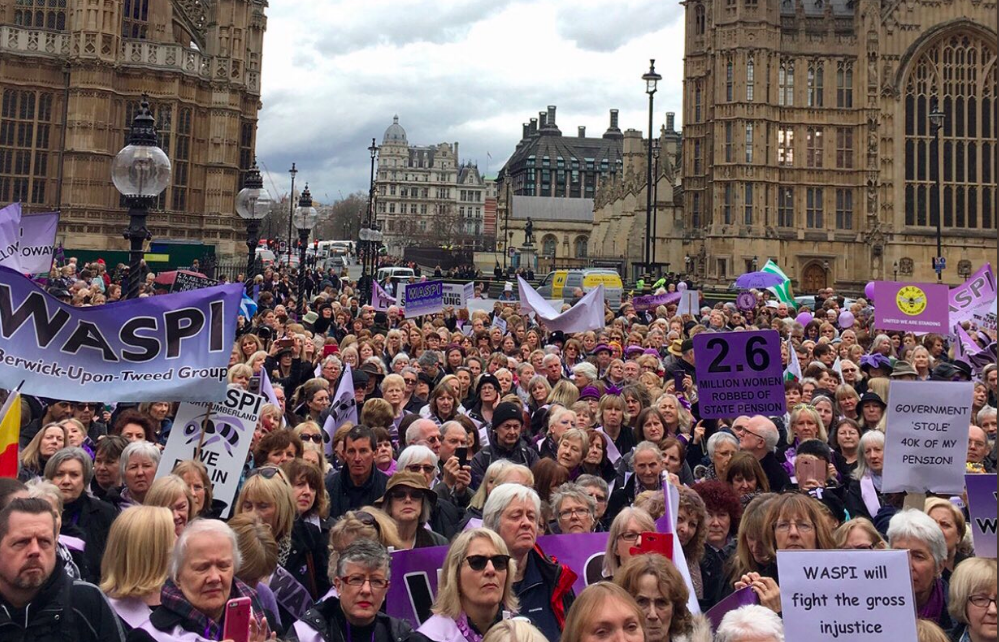
This view is endorsed by WASPI (Women Against State Pension Inequality), a nationwide movement established in 2015 to fight for justice for the generation of women penalised by the “poorly implemented” rise in their state pension age from 60 to 66.
Today a judicial review begins, brought on the basis of sex discrimination by separate campaign group Back to 60. The landmark review in the High Court will examine the government’s handling of the rise in the pension age for women born in the 1950s, who were the first to see their pension age fall in line with men.
The Pensions Act 1995 stated that the state pension age for women would increase from 60 to 65 from April 2010 to 2020, however the coalition government accelerated the timetable with the Pensions Act 2011. Under the new act the state pension age would reach 65 by November 2018 and 66 by April 2020, to reflect life expectancy.
While the government claims to have paid for articles in newspapers and TV advertising to communicate the changes, WASPI research suggests that these were mostly in the financial sections of broadsheet newspapers and not aimed directly at the generation impacted.
“The government knew that it would be unpopular and nobody voluntarily chooses to draw attention to something that they know is going to be very unpopular,” states Debbie de Spon, WASPI communications director.
“As a campaign we also suspect that successive governments thought we were an easy target and that we wouldn’t make a fuss about it.”
They were wrong. Some women did notice and in 2011 complained about the changes, which resulted in the coalition government agreeing to push the rise to 66 back from April 2020 to October 2020.

“As a result the 2011 Act didn’t increase the state pension age as much as it was intended to do, which meant the government didn’t save as much money off the backs of WASPI women as they had hoped,” says de Spon.
“It’s also a question less about equalising the state pension age, which is what it’s been dressed up as, but rather it was about the government saving money that it very badly needed to save.”
Some four years later in March 2015 the Work and Pensions Select Committee concluded that “more could and should have been done” in communicating to these women.
The decision not to inform the 1950s generation goes right to the heart of government. Writing in the I newspaper in October 2018 Baroness Ros Altman, who served as pensions minister between 2015 and 2016, claimed that the then Secretary of State Iain Duncan Smith refused to engage with the women adversely affected and that she was “instructed not to speak to them”. The feeling at the time was that the women would go away sooner or later.
Altman goes on to state: “The Department for Work and Pensions had failed to properly inform those affected by the huge 1995 changes. Indeed, the DWP inadvertently led these women to believe their state pension age was 60.
“It wrote to millions of them between 2003 and 2005 about their state pension, without bothering to mention that they would not be getting it at age 60. Even in 2015, when women’s pension age had already risen to 62, some pages on the Government’s website said women would start their state pension at age 60.”
Achieving financial security
The far-ranging impact the change in pension age has had on the generation of 1950s women cannot be overstated. Finding themselves with a six-year gap in their savings has, in many cases, taken financial independence away from women who expected that when they reached 60 there would be money put aside.
For those women who have partners and husbands the changes have often meant relying on them to make ends meet, while de Spon explains that others feel like they are on the brink of disaster.
“I speak to women who often say ‘I’m frightened that tomorrow I’ll be too ill or my condition will be too bad for me to actually go to work and I have to munch on painkillers in order to get me through’,” she recalls.
“Even if you put to one side the financial situation of people who are most struggling which obviously we consider all the time, we also consider the women who did plan, who did make arrangements.”
De Spon cites one of her oldest friends who carefully planned for her retirement, only to find out a few years prior that a huge chunk of her expected state pension – up to £45,000 – would disappear.

While WASPI celebrates flexible working, enhanced parental leave and auto-enrolment being offered to younger generations as they are passionate about women achieving financial security, such opportunities were not open to them. In fact, the government’s decision to equalise the state pension age fails to take into account the significant societal factors affecting this generation.
Not only did they have to contend with the persistent gender pay gap, but these women did not have the ability to access enhanced maternity leave packages, nor were the majority offered flexible working, which invariably meant that having a baby or taking time off to care for a family member would see their career effectively stop.
“We’re also more of a generation where the woman was expected to stay at home and look after the children and husbands went out to work. That was much more normal and it certainly couldn’t be called normal today,” de Spon points out.
“That was the way it was so therefore, if women did work, they probably only worked part time and if you work part time you couldn’t join a company pension scheme which meant that women of our generation had less opportunity to have a private pension and are therefore more dependent on their state pension.”
The upshot is that women, sometimes after years out of work, are being forced to get back into the workforce in their early 60s or sign on for Universal Credit. In other cases these women are being pushed into unstable zero hours contract work to pay the bills.
“The government claims that [zero-hours contracts] offers greater flexibility, but my only experience is that they offer a complete lack of flexibility and security, and a lot of anxiety with people not knowing until the morning or the evening before if they are going to work. What kind of life is that for anybody?” de Spon questions.
While there is far more information available now and the Department for Work and Pensions has been consistently promoting its workplace pensions scheme, she believes far more emphasis needs to be put on how people are going to support themselves financially in later life.
“We suspect that successive governments thought we were an easy target and that we wouldn’t make a fuss about it.”
Debbie de Spon, WASPI
Such an approach will be crucial going forward as life expectancy rises. By 2028, for example, the state pension age is expected to reach 67. This means that as a society – and particularly employers – we will need to find new ways for people work into older age.
De Spon believes fundamental change is needed to help people make adaptions through their working life. “Will HR sit you down and say well, how is it for you, how are you managing, how can we consider what your working life is going to look like for the next five to 10 years?,” she questions.
“I don’t think in most circumstances that happens yet and is that going to happen in the future? Are we going to really look at the needs of the workforce if we’re all going to have to work into our 70s?”
Bridging the gap
WAPSI does not oppose equalising the pension age, but it is asking for compensation for a generation of women who were given little to no warning of the changes and therefore were unable to make up the six-year financial shortfall.
The group is calling for a ‘bridging’ pension to provide an income until the women reach state pension age – non-means-tested and with recompense for losses for those who have already reached retirement.
To date WASPI has taken a two pronged attack. The first was a political campaign, lobbying MPs to gain support for the bridging pension. However, while the group has received genuine cross-party support, de Spon argues that the government has no will to give the group any money as it needs to save – not spend more.
Simultaneously WAPSI lodged a complaint of maladministration with the Department for Work and Pensions, which is now with an independent case examiner. The goal is to push the complaint all the way through to the parliamentary ombudsman who could, in theory, decide this generation of women should be put back in the position they would have been had the “maladministration” of their pensions not occurred.
The judicial review brought by Back to 60 has, however, put the WASPI maladministration complaint temporarily on hold.
“Even at the end of the judicial review we probably won’t know immediately because DWP and the ombudsman will want to consider what the ruling was and how that affects the way forward for our complaints process, so it’s a real wait and see at the moment,” says de Spon.
“We’re all marking the days on our calendar until we get an idea of how we move forward.”
The experience of the WASPI women is an example of what if feels like to realise the safety net you always thought would be there to catch you has disappeared and time has run out to do anything about it. A generation of women have been – in the words of the UN rapporteur – “severely and unconscionably penalised” in a bid to recoup money to the public purse.
Alston clearly points to the way women, particularly the WASPI generation, have been put at a “systematic disadvantage” by the state, suggesting not only a right to compensation, but also the need for the government to address how it treats the most vulnerable in society. Furthermore, this should be a wake up call for future generations to redefine our career trajectories as we prepare to work well into our 70s.


 JADED
JADED 
Leave a comment